Being a competent pool swimmer does not make you a competent triathlon swimmer. After coaching hundreds of triathletes over three decades, the same fundamental mistakes appear again and again. Here is what they are and exactly how to fix them.
The Problem With Pool Swimmers
Pool swimming is a controlled environment. The water is clear. The lane is straight. There are walls at each end. You know exactly where you are at all times.
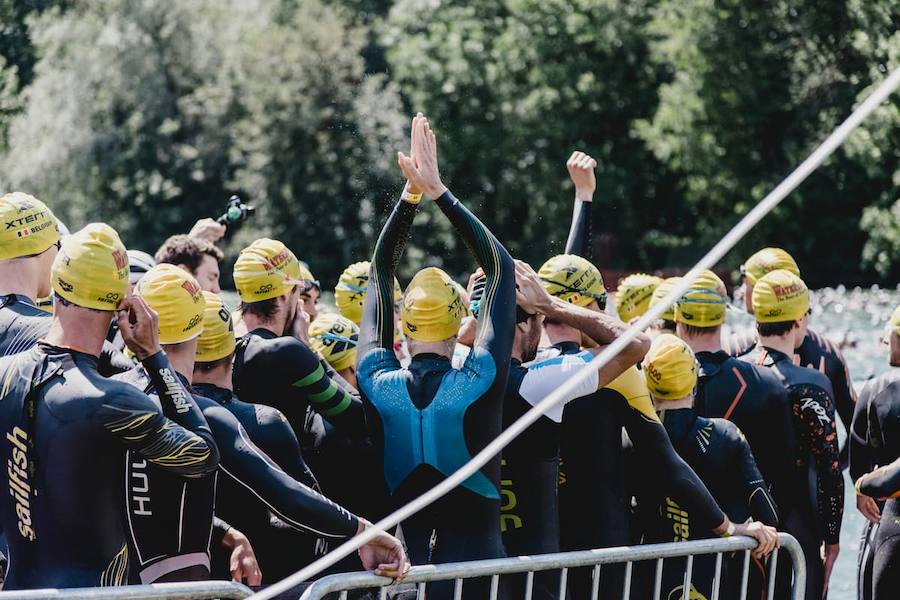
Triathlon swimming is none of those things. Open water is murky, cold, choppy and full of other people trying to swim over you. The start is chaotic. The course is a rough triangle with buoys you cannot always see. And you have a 40km bike ride and a 10km run waiting for you at the other end.
Pool fitness is necessary but not sufficient. You also need open water competence, race-specific skills, and the ability to stay calm when it all goes wrong at the start.
None of this means your pool background is worthless — far from it. The engine is there. The technique foundation is there. What is missing is race-specific adaptation.
Mistake 1 — The Bilateral Breathing Dogma
Most club swimmers are taught to breathe bilaterally — alternating sides every three strokes. It is excellent for technique development in the pool. It promotes balance and prevents a lopsided stroke.
In a triathlon, rigid bilateral breathing is a liability. If you are being swum over on your left and you are breathing left on that stroke, you will take a mouthful of water. In open water you often need to breathe on a specific side to sight a buoy or because waves are coming from one direction.
What to practise: Swim sets where you consciously switch your breathing pattern mid-length. Breathe right for 25m, then left for 25m, then every two strokes for 25m. Build flexibility rather than dependence on a pattern.
Mistake 2 — Pool Turn Mentality
In pool swimming, the walls are your friend. You push off, get 5 free metres of momentum, and reset. In open water there are no walls, and the triathlete who relies on turns to catch their breath every 25 metres is going to struggle.
This manifests as an inability to sustain pace for 400m+ without a natural break. The swimmer is aerobically capable but has not trained continuous swimming.
- Replace short-course sets with continuous distance work
- Practise 400m+ time trials without stopping
- When pool training, swim through the walls — touch and go only, no push-off
- Add open water sessions in the 8 weeks before your race
Mistake 3 — Ignoring Sighting
Sighting is lifting your eyes above the waterline to locate a buoy or landmark, then returning to your stroke without disrupting your rhythm or sinking your hips. Most pool swimmers have never practised it.
Poor sighting is catastrophically expensive. I have seen athletes add 200m to their swim by drifting off course. At open water pace that is 4–5 extra minutes — often the difference between transitions.
The correct technique: Lead with your chin rather than your forehead. Look forward briefly, locate the buoy, return to your normal head position. Practise it as a drill: every 10 strokes, perform one sighting stroke.
Mistake 4 — Overcooking the Start
The excitement of race day, the proximity of other bodies, the adrenaline — it causes almost every swimmer to go out too fast. For a pool swimmer with a decent engine, this feels sustainable for the first 100 metres. By 300 metres, they are in difficulty.
- Know your target pace per 100m and stick to it for the first 200m
- Seed yourself correctly — do not go out with the front pack if you are not at that level
- Find feet to draft behind early and settle in
- Consciously ease back in the first 50 metres, then build
Mistake 5 — Never Training in the Wetsuit
A wetsuit lifts your hips — mostly positive. But it also restricts shoulder rotation, alters your breathing and can cause upper body fatigue in swimmers who are not used to it.
Most club swimmers put the wetsuit on for the first time on race morning. This is a mistake. You need at least three or four full-effort swims in your wetsuit before race day to adapt your stroke and know how it feels when you are working hard.
Rule of thumb: Wear your wetsuit for your last three long training swims before your race. Never race in a wetsuit you haven’t trained in at pace.
A 6-Week Fix
If your race is six weeks away and you recognise yourself above, here is a practical focus:
- Weeks 1–2: Continuous swim sets. Replace all short-course sets with 400m+ non-stop blocks. Focus on sustainable pace and breathing flexibility.
- Weeks 3–4: Introduce sighting drills in every pool session. Add one open water swim if possible. First wetsuit session.
- Weeks 5–6: Race simulation. Simulate the start, practise drafting, do two more wetsuit sessions. Focus on pacing — controlled first 200m, build from there.
If you want to work on any of this with a coach, I offer 1-to-1 sessions at our 25m pool in Borehamwood specifically for triathletes. Get in touch to book.